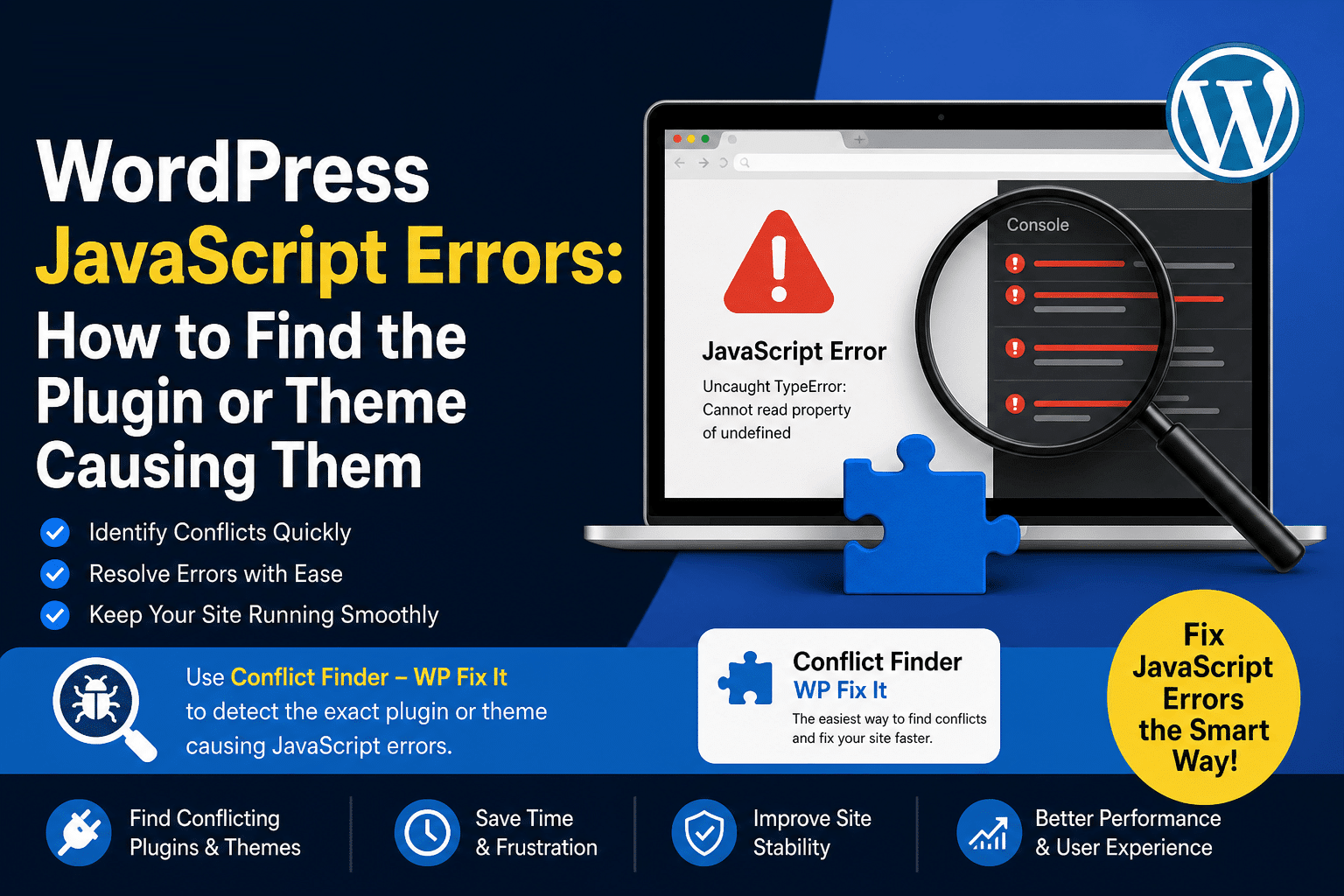

WordPress JavaScript errors can turn a normal website into a frustrating guessing game. One moment your menu works, your form submits, your slider loads, and your checkout page behaves exactly as expected. Then a plugin update, theme change, caching adjustment, or custom script causes something to stop working.
The hardest part is that WordPress JavaScript errors do not always look like obvious errors. Sometimes a button simply stops responding. Sometimes the block editor will not load. Sometimes a popup will not open, a form will not validate, a mobile menu will not expand, or WooCommerce checkout will freeze before payment. Behind the scenes, the browser console may be showing a clear JavaScript error, but the visible problem looks like a broken feature.
In many cases, WordPress JavaScript errors are caused by a plugin conflict, theme conflict, incorrect script loading order, missing dependency, optimization setting, outdated code, or cached file. WordPress uses an enqueue system for loading scripts, and the official WordPress developer documentation explains that wp_enqueue_script() should be used with the proper hooks for loading scripts on the front end, admin screens, or login screen. (WordPress Developer Resources)
This guide will show you how to find the plugin or theme causing WordPress JavaScript errors, how to confirm the conflict safely, and how to use the free Conflict Finder WordPress troubleshooting plugin from WP Fix It to speed up the process.
What Are WordPress JavaScript Errors?
WordPress JavaScript errors happen when JavaScript code running in the browser fails, stops, loads in the wrong order, cannot find a required file, or tries to use something that does not exist on the page. JavaScript controls many interactive parts of a WordPress site, including menus, sliders, popups, accordions, form validation, analytics events, checkout actions, page builders, block editor features, lazy loading, and many admin dashboard tools.
A single JavaScript error can prevent other scripts from running correctly. That is why one broken plugin script can appear to break several unrelated parts of a site.
Common examples of WordPress JavaScript errors include:
Uncaught TypeError: Cannot read properties of undefined
jQuery is not defined
Uncaught ReferenceError
Failed to load resource
SyntaxError: Unexpected token
Cannot read properties of null
Uncaught TypeError: $ is not a function
These messages may look technical, but they usually point to a specific JavaScript file, plugin folder, theme folder, or script dependency. MDN Web Docs is a strong general reference for JavaScript errors and web platform behavior, while Chrome DevTools provides browser tools for diagnosing page issues directly in Chrome. (MDN Web Docs)
The goal is not always to rewrite JavaScript yourself. The goal is to identify where the error begins, whether a plugin or theme is responsible, and what changed before the problem started.
Why WordPress JavaScript Errors Often Come From Plugins or Themes
WordPress is flexible because plugins and themes can add scripts to almost every part of a site. That flexibility is powerful, but it also means many different code sources may be trying to control the same page.
A form plugin may load validation scripts. A page builder may load animation scripts. A theme may load menu scripts. A performance plugin may combine and defer scripts. A WooCommerce extension may load checkout scripts. A security plugin may modify script behavior. A tracking plugin may inject third-party JavaScript.
Most of the time, everything works together. But WordPress JavaScript errors can appear when one script expects another script to load first, when a plugin loads an older library, when a caching plugin delays a required file, or when a theme uses JavaScript that conflicts with a plugin.
WordPress recommends using its script enqueue functions because they help manage dependencies and loading order. When plugins or themes bypass that system, hardcode scripts, load duplicate libraries, or fail to declare dependencies properly, JavaScript conflicts become more likely. (WordPress Developer Resources)
This is why troubleshooting should be organized. Randomly changing settings may hide the issue temporarily, but it rarely proves the true cause.
Symptoms of WordPress JavaScript Errors
WordPress JavaScript errors can affect both the front end and admin area. You may notice problems such as:
Forms that will not submit.
Dropdown menus that will not open.
Mobile navigation that no longer responds.
Buttons that do nothing when clicked.
WooCommerce cart or checkout pages freezing.
Sliders, galleries, or carousels not loading.
Popups or modals failing to display.
Page builder controls not working.
The WordPress block editor showing a blank screen.
Admin dashboard screens loading partially.
Console errors appearing after a plugin, theme, or WordPress update.
When several interactive features break at once, it is a strong sign that a JavaScript file failed early and stopped other scripts from completing. WordPress JavaScript errors can also be page-specific. For example, only the checkout page may break because that is where a payment plugin loads its scripts. Or only the contact page may break because that is where a form plugin loads validation code.
Step 1: Open the Browser Console
The first step in diagnosing WordPress JavaScript errors is to check the browser console.
In Chrome, right-click the page and choose Inspect, then open the Console tab. Reload the page and watch for red error messages. Chrome DevTools is built into Chrome and is designed to help diagnose page problems quickly. (Chrome for Developers)
Look for clues in the error message. The most useful clue is often the file path. For example:
/wp-content/plugins/example-plugin/assets/js/frontend.js
This points toward a plugin.
/wp-content/themes/example-theme/js/navigation.js
This points toward the active theme.
/wp-content/cache/
This may point toward cached, combined, deferred, or minified files.
This may point toward an external service, tracking script, embedded widget, ad script, map, chat tool, or payment integration.
Write down the exact error message, affected page URL, and file path. This gives you a starting point before you deactivate anything.
Step 2: Clear Cache and Disable Script Optimization Temporarily
Before assuming a plugin or theme is broken, clear all layers of cache. WordPress JavaScript errors can be caused by outdated cached files, combined scripts, or delayed JavaScript settings.
Clear your WordPress caching plugin cache, hosting cache, CDN cache, and browser cache. Then test again in a private browsing window.
Next, temporarily disable performance settings that affect JavaScript. These may include:
Minify JavaScript.
Combine JavaScript files.
Defer JavaScript.
Delay JavaScript execution.
Move scripts to footer.
Remove unused JavaScript.
Load JavaScript asynchronously.
These settings can improve performance when configured correctly, but they can also change script order. When a script depends on jQuery, WooCommerce checkout scripts, a form validation library, or a page builder asset, loading it too late can trigger WordPress JavaScript errors.
After disabling optimization settings, reload the broken page and check the console again. If the error disappears, the conflict may be in the performance configuration rather than the plugin itself.
Step 3: Use Conflict Finder to Isolate the Plugin or Theme
The fastest organized way to find the source of WordPress JavaScript errors is to test for plugin and theme conflicts. This is where Conflict Finder – WP Fix It is useful.
Conflict Finder is a WordPress troubleshooting plugin designed to help administrators and support professionals diagnose plugin conflicts, theme issues, debugging errors, and email delivery problems from one interface. Its listed tools include WP_DEBUG management, temporary plugin deactivation with restore support, activating plugins one at a time to identify conflicts, theme conflict testing, and email delivery testing. (WordPress.org)
The plugin is especially helpful because WordPress JavaScript errors often require a process of elimination. Instead of guessing which plugin is responsible, you can temporarily deactivate active plugins, restore previous plugin states, and reactivate plugins one by one until the JavaScript error returns.
You can also read WP Fix It’s related guide on how to diagnose WordPress plugin conflicts with Conflict Finder for a deeper look at the tool.
Step 4: Test Plugins One at a Time
Once you have a safe testing process, begin plugin isolation.
Start by confirming the error exists with all normal plugins active. Open the broken page, reload it, and check the console. Then use Conflict Finder to temporarily deactivate active plugins. Test the same page again.
If the WordPress JavaScript errors disappear when plugins are deactivated, one of the plugins is likely responsible.
Now reactivate plugins one at a time. After each activation, reload the affected page and check whether the error returns. The moment the same JavaScript error returns, the last plugin activated is likely the conflict source.
This does not always mean the plugin is poorly built. It may conflict with another plugin, the active theme, a caching setting, a third-party script, or a specific page builder module. But this step tells you where to focus.
For example, if the error appears only after activating a slider plugin, inspect the slider plugin’s JavaScript files. If the error appears only after activating a checkout extension, test the WooCommerce checkout page. If it appears only after activating a performance plugin, review JavaScript optimization settings.
For more help from WP Fix It, bookmark WordPress plugin conflict troubleshooting.
Step 5: Test the Theme
If plugin testing does not reveal the source, test the active theme.
A theme can cause WordPress JavaScript errors through navigation scripts, customizer scripts, page templates, animation libraries, bundled sliders, outdated jQuery code, or custom JavaScript added to header and footer areas.
Conflict Finder includes a theme conflict tool that can temporarily switch to another installed theme and restore the original theme afterward. (WordPress.org)
When testing the theme, switch to a default WordPress theme or another clean theme available on the site. Then reload the page and check the console. If the JavaScript error disappears after switching themes, the issue is likely inside the active theme or its theme-specific settings.
Common theme-related causes include:
A custom mobile menu script failing.
A theme-bundled slider using outdated JavaScript.
A template file missing required markup.
A theme loading jQuery incorrectly.
Custom JavaScript added inside theme options.
A child theme overriding scripts from the parent theme.
If the issue is theme-related, avoid editing the parent theme directly. Use a child theme, custom plugin, or professional repair process so changes are not overwritten during updates.
Step 6: Compare the Error File Path
The browser console often tells you where to look. If the file path includes /plugins/, inspect that plugin. If it includes /themes/, inspect the active theme. If it includes /cache/, inspect your optimization plugin or CDN cache. If it includes a third-party domain, inspect that external script.
Here is how to interpret common file paths:
/wp-content/plugins/contact-form-plugin/
Likely related to a form plugin.
/wp-content/themes/current-theme/
Likely related to your active theme.
/wp-content/uploads/
Could be a generated asset, custom script, or page builder output.
/wp-content/cache/
Could be a combined or minified file from a caching plugin.
/wp-includes/js/
Could be WordPress core script usage, but often the problem is a plugin or theme calling that script incorrectly.
A WordPress core file appearing in the console does not automatically mean WordPress core is broken. Often, a plugin or theme passes bad data into a core script or tries to use a dependency before it is ready.
Step 7: Check for jQuery Problems
Many WordPress JavaScript errors involve jQuery because many older plugins and themes depend on it.
One common error is:
$ is not a function
This often means the script expects $ to represent jQuery, but WordPress loads jQuery in no-conflict mode. Another common error is:
jQuery is not defined
This usually means jQuery did not load before a script that needed it.
WordPress plugin and theme developers should declare jQuery as a dependency when enqueueing scripts. The official WordPress wp_enqueue_script() documentation explains how scripts are registered and loaded through WordPress’s script system. (WordPress Developer Resources)
If you are not a developer, you do not need to fix the code yourself. You just need to identify whether the plugin or theme responsible is loading JavaScript incorrectly. Once identified, you can update it, replace it, report the bug to the developer, or get expert WordPress help from WP Fix It WordPress support.
Step 8: Turn On WordPress Debugging Carefully
JavaScript errors appear in the browser console, but related PHP warnings or notices may also help reveal the root cause. WordPress has a built-in debug mode controlled by the WP_DEBUG constant. The official WordPress documentation explains that WP_DEBUG triggers WordPress debug mode and is usually set in the wp-config.php file. (WordPress Developer Resources)
Conflict Finder can help manage WP_DEBUG without manually editing files, and it includes debug log viewing, downloading, and clearing features according to the plugin listing. (WordPress.org)
Use debug mode carefully on a live site. In most cases, errors should be logged instead of displayed publicly. Public error display can expose file paths or technical information to visitors.
Debug logs are especially useful when a JavaScript error appears after a PHP warning, missing asset, shortcode failure, AJAX error, REST API problem, or plugin initialization issue.
Step 9: Test in a Staging Environment When Possible
If your website is an active business site, membership site, online store, or high-traffic publication, use a staging site whenever possible. Staging lets you deactivate plugins, switch themes, and adjust optimization settings without affecting real visitors.
That said, many site owners need to diagnose WordPress JavaScript errors quickly on a live site. In that case, use the least disruptive approach:
Test during low-traffic hours.
Take a full backup first.
Record original plugin and cache settings.
Use a troubleshooting tool that can restore previous states.
Avoid changing multiple things at once.
Check the exact same page after every change.
The goal is to isolate the conflict, not create a new one.
Step 10: Fix the Confirmed Cause
Once you find the plugin or theme causing WordPress JavaScript errors, choose the safest fix.
Start with updates. Update WordPress core, the active theme, and the conflicting plugin. Also update related add-ons. For example, if a WooCommerce payment add-on conflicts with a checkout optimization plugin, update WooCommerce, the payment plugin, and the optimization plugin.
Next, check settings. If the issue is caused by deferred JavaScript, delayed JavaScript, combined files, or minification, exclude the affected script from optimization.
If the plugin itself is the issue, contact the plugin developer with the exact console error, affected URL, WordPress version, PHP version, theme name, and steps to reproduce. Clear reports get fixed faster.
If the theme is the issue, check whether a theme update is available. If custom code caused the error, move the fix into a child theme or custom plugin.
If the conflict cannot be fixed quickly, replace the plugin or disable the feature causing the issue. A stable site is more important than keeping a specific plugin that breaks key functionality.
How Conflict Finder Helps With WordPress JavaScript Errors
Conflict Finder is useful because it turns a messy troubleshooting process into a controlled workflow. Instead of guessing, you can test plugins and themes in a structured way.
For WordPress JavaScript errors, the most useful Conflict Finder features are:
Temporary plugin deactivation.
Saving and restoring plugin states.
Activating plugins one at a time.
Theme conflict testing.
WP_DEBUG management.
Debug log viewing.
These features match the real troubleshooting path for JavaScript conflicts: confirm the error, remove variables, reintroduce plugins, test the theme, check logs, and restore the site state.
You can install it from the official WordPress plugin directory here: Conflict Finder plugin for WordPress JavaScript error troubleshooting.
When to Ask for Expert Help
Some WordPress JavaScript errors are easy to solve. Others require deeper investigation.
Ask for expert help when:
The checkout page is broken.
The admin dashboard is inaccessible.
The block editor will not load.
The error affects paid ads or conversions.
The site has custom code.
The problem returns after every update.
The console error points to multiple plugins.
A caching or CDN setup makes testing confusing.
The JavaScript error is connected to AJAX, REST API, security rules, or server errors.
WP Fix It provides WordPress support and repair services through 24/7 WordPress help from WP Fix It. If a broken script is hurting sales, leads, or user experience, professional troubleshooting may be faster than trial and error.
How to Prevent WordPress JavaScript Errors
You cannot prevent every conflict, but you can reduce the risk.
Keep WordPress, plugins, and themes updated. Remove plugins you no longer use. Avoid installing multiple plugins that do the same job. Test major updates on staging first. Use a reliable theme. Avoid copying random JavaScript snippets into header and footer fields unless you understand what they do.
Be careful with performance plugins. JavaScript optimization is helpful, but aggressive settings can break interactive features. After enabling defer, delay, minify, or combine settings, test menus, forms, checkout, popups, sliders, account pages, and admin screens.
Use the browser console as part of your normal maintenance routine. A page can appear fine visually while still showing JavaScript errors that reduce reliability.
Most importantly, troubleshoot one change at a time. When several plugins are updated, cache settings are changed, and a theme is modified in the same session, it becomes much harder to identify the source of WordPress JavaScript errors.
Final Thoughts
WordPress JavaScript errors are frustrating because they often break visible features without explaining the cause on the page. But the troubleshooting process becomes much easier when you use the browser console, check file paths, clear caches, disable script optimization temporarily, and isolate plugins and themes one by one.
The most important step is controlled testing. Do not guess. Confirm the error, remove variables, reactivate plugins one at a time, test the theme, and document what changes.
For a faster process, install Conflict Finder – WP Fix It for WordPress JavaScript errors. It helps identify plugin conflicts, test theme issues, manage debugging, and restore previous plugin states from a single troubleshooting interface.
When WordPress JavaScript errors are handled methodically, you can find the source faster, protect your site from unnecessary downtime, and restore the interactive features your visitors depend on.